Vertical Phased Array Antenna System
Technical Design for HF Shore Station Operations
This document specifies a four-element vertical phased array antenna system for HF beyond-line-of-sight (BLOS) communication. The array provides electronic beam steering across 270° azimuth with selectable elevation angles for both long-range skywave and near-vertical incidence skywave (NVIS) propagation modes.
1. System Overview
The four-element square array configuration offers an excellent balance between complexity and capability for shore-based HF operations. Elements V1–V4 are vertical monopoles with individual phase control (φ₁–φ₄), managed by a central Phase Control Unit (PCU).
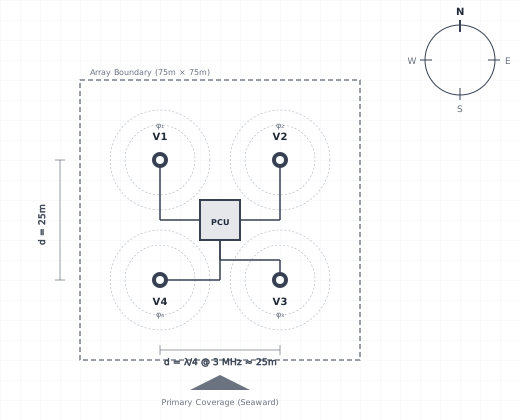
Figure 1
Four-element square array configuration. Elements V1–V4 are vertical monopoles with individual phase control (φ₁–φ₄). PCU = Phase Control Unit. Dashed circles indicate ground radial extent.
⬤ Vertical Element ▢ Phase Control Unit ◯ Ground Radials (dashed)
2. Vertical Element Design
Each element is a quarter-wave vertical monopole optimized for broadband operation across the HF spectrum.
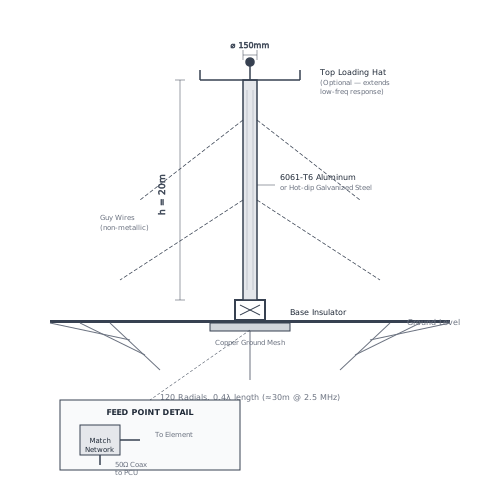
Figure 2
Single vertical monopole element showing structural components, feed arrangement, and ground system interface. Height optimized for quarter-wave resonance at 3.75 MHz with broadband matching network.
Element Specifications
| Component | Specification |
|---|---|
| Height | 20 meters |
| Diameter | 150mm |
| Material | 6061-T6 Aluminum or Hot-dip Galvanized Steel |
| Base | Insulated mount with matching network |
| Guy wires | Non-metallic (Kevlar or fiberglass) |
| Top loading | Optional 2m diameter hat for extended low-frequency response |
Feed Point Detail
The feed point includes a broadband matching network that transforms the antenna impedance to 50Ω for connection to the Phase Control Unit via coaxial cable.
3. Electrical Specifications
| Parameter | Specification | Notes | |
|---|---|---|---|
| Frequency | Operating Range | 2.0 – 30.0 MHz | Full HF band coverage |
| Optimum Range | 3.0 – 18.0 MHz | Best VSWR and pattern | |
| NVIS Mode | 2.0 – 10.0 MHz | Near-vertical incidence | |
| Array Gain | Broadside (4 elements) | 10 – 12 dBi | At beam peak |
| Single Element | 0 – 2 dBi | Over perfect ground | |
| Array Factor | +6 dB | 4-element coherent sum | |
| Beam Steering | Azimuth Range | 270° continuous | Seaward coverage |
| Elevation Range | 15° – 90° | Long-range to NVIS | |
| Beamwidth | Azimuth (−3 dB) | 45° – 60° | Frequency dependent |
| Elevation (−3 dB) | 20° – 40° | Frequency dependent | |
| Impedance | Element Feed | 50Ω nominal | After matching network |
| Array Port | 50Ω | Single combined feed | |
| VSWR | Optimum Band | ≤ 1.5:1 | 3–18 MHz |
| Extended Band | ≤ 2.5:1 | 2–30 MHz | |
| Power Rating | Continuous | 10 kW PEP | Per element, 40 kW array |
4. Phasing Network Architecture
The Phase Control Unit (PCU) is the heart of the array, providing individual phase and amplitude control for each element.
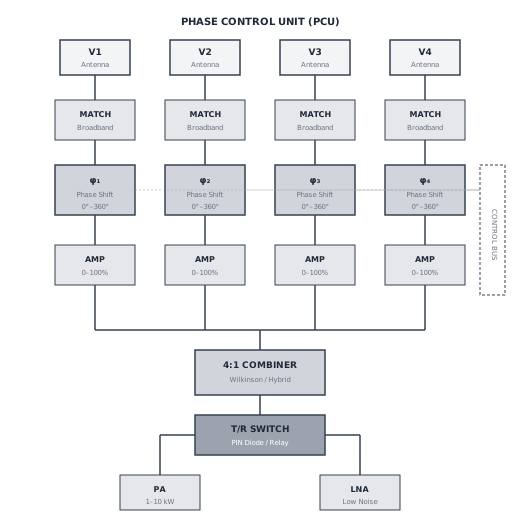
Figure 3
Complete signal path from antenna elements through phase/amplitude control to combined RF port. Control bus provides digital interface for beam steering commands.
Signal Path Components
- Broadband Matching Networks — Transform antenna impedance to 50Ω
- Variable Phase Shifters — 0°–360° range with ≤1° resolution
- Amplitude Control — 0–100% for pattern shaping and null steering
- 4:1 Wilkinson Combiner — Combines all four channels to single port
- T/R Switch — PIN diode or relay for transmit/receive isolation
- PA (Transmit) — 1–10 kW power amplifier
- LNA (Receive) — Low noise amplifier for receive sensitivity
Phase Steering Equations
For a planar array with elements at positions (xn, yn), the required phase shift to steer the beam to azimuth θ and elevation ψ is:
φn = −(2π/λ) · [xn sin(θ) cos(ψ) + yn cos(θ) cos(ψ)] — Eq. (1)
For the square 4-element array with spacing d:
φ₁ = −(πd/λ) · [sin(θ) + cos(θ)] cos(ψ) — Eq. (2a)
φ₂ = −(πd/λ) · [sin(θ) − cos(θ)] cos(ψ) — Eq. (2b)
φ₃ = −(πd/λ) · [−sin(θ) − cos(θ)] cos(ψ) — Eq. (2c)
φ₄ = −(πd/λ) · [−sin(θ) + cos(θ)] cos(ψ) — Eq. (2d)
Implementation Note: Phase shifters must accommodate the full 0°–360° range with resolution ≤1° to maintain beam pointing accuracy within ±2° across the operating band. For frequencies above 15 MHz, 0.1° resolution is recommended.
5. Ground System Requirements
An inadequate ground system is the most common cause of poor vertical antenna performance.
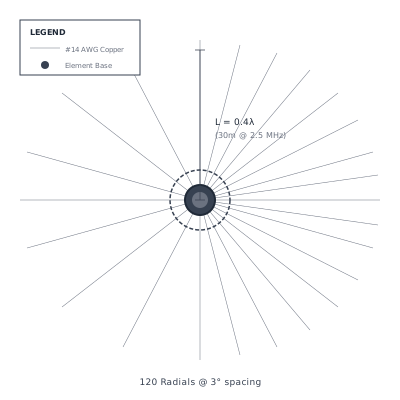
Figure 4
Ground radial layout for single vertical element. 120 radials at 3° angular spacing, each 0.4λ long at lowest operating frequency. Radials buried 50–100mm below grade.
Ground System Specifications
| Parameter | Specification | Performance Impact |
|---|---|---|
| Number of radials | 120 per element | Diminishing returns above 120; 60 minimum acceptable |
| Radial length | 0.4λ @ fmin (≈30m) | Shorter radials increase ground loss 1–3 dB |
| Radial material | #14 AWG bare copper | Phosphor bronze for coastal (corrosion) |
| Burial depth | 50–100mm | Surface-laid acceptable but less durable |
| Center ground mesh | 3m × 3m copper mesh | Reduces feed point ground resistance |
| Soil conductivity (desired) | >10 mS/m | Coastal sites typically 20–30 mS/m |
Critical Design Consideration: A vertical with 16 radials over poor soil may exhibit 6 dB higher ground loss compared to 120 radials over good soil. This 6 dB difference is equivalent to reducing transmitter power from 10 kW to 2.5 kW. Ground system investment yields the highest return per dollar in any vertical antenna installation.
6. Site Layout
A complete installation requires approximately 4.5 acres (150m × 120m minimum).
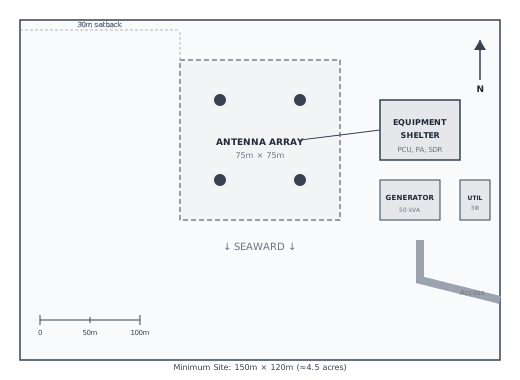
Figure 5
Recommended site layout showing antenna array, equipment shelter, backup power, and access. Array positioned for seaward coverage with 30m minimum setback from boundaries.
Site Components
| Component | Specification |
|---|---|
| Antenna Array | 75m × 75m for four elements with radial systems |
| Equipment Shelter | Housing for PCU, power amplifiers, and SDR equipment |
| Backup Power | 50 kVA generator for off-grid operation |
| Utility Connection | 3-phase power |
| Setbacks | 30m minimum from site boundaries |
| Access | All-weather road to equipment shelter |
The array should be oriented with the primary coverage sector (typically 270°) facing seaward or toward the intended coverage area.
7. References
- Kraus, J.D. and Marhefka, R.J., Antennas for All Applications, 3rd ed., McGraw-Hill, 2002.
- ARRL, The ARRL Antenna Book, 24th ed., American Radio Relay League, 2019.
- Sevick, J., Transmission Line Transformers, 4th ed., Noble Publishing, 2001.
- MIL-STD-188-141D, Interoperability and Performance Standards for Medium and High Frequency Radio Systems, 2017.
- ITU-R P.533, Method for the Prediction of the Performance of HF Circuits, 2019.