Software-Defined Radio System Architecture
Signal Chain Design from RF Front-End to Digital Baseband
This document presents a systematic treatment of software-defined radio (SDR) architecture, covering the complete signal path from antenna to demodulated data. SDR systems replace fixed-function analog circuits with programmable digital signal processing, enabling a single hardware platform to implement arbitrary radio standards through software configuration. The treatment emphasizes practical design trade-offs, real component parameters, and the signal-theoretic foundations that govern system performance.
1. Introduction
1.1 From Hardware to Software
Traditional radio receivers implement frequency selection, demodulation, and filtering using analog circuits optimized for specific signal types. A crystal radio selects one station; a superheterodyne receiver is built for one modulation scheme and bandwidth. Software-defined radio moves these functions into the digital domain, performing signal processing on digitized samples rather than continuous-time signals.
The concept was first formalized by Mitola (1991), who proposed the “ideal software radio” — a system where the ADC sits directly at the antenna, digitizing the entire electromagnetic spectrum, with all selectivity and demodulation performed in software. While this ideal remains impractical (the RF spectrum spans DC to 300 GHz, requiring absurdly high sample rates and bit depths), modern SDR systems approximate it within practical bands by placing the ADC as close to the antenna as technology allows.
1.2 The Practical SDR Continuum
Real SDR systems exist on a continuum between fully analog and fully digital:
| Level | Description | ADC Position | Example |
|---|---|---|---|
| 0 | Fully analog | None | Crystal radio |
| 1 | Software-controlled | After full demod | Scanner with serial control |
| 2 | Software-defined (IF) | After IF stage | WinRadio, IC-7610 |
| 3 | Software-defined (RF) | After LNA | RTL-SDR, ANAN-G2 |
| 4 | Ideal software radio | At antenna | Theoretical limit |
Table 1 The SDR continuum from analog to ideal.
This document focuses on Level 2–3 architectures, which represent the current state of practical SDR engineering.
1.3 Advantages and Trade-offs
| Characteristic | Traditional Radio | Software-Defined Radio |
|---|---|---|
| Flexibility | Fixed modulation | Arbitrary waveforms |
| Reconfigurability | Hardware modification | Software update |
| Multi-mode operation | Separate receivers | Single platform |
| Obsolescence | Hardware-limited | Software-upgradeable |
| Power consumption | Lower (analog) | Higher (digital processing) |
| Dynamic range | Excellent (analog AGC) | ADC-limited |
| Latency | Near-zero (analog) | Processing pipeline delay |
Table 2 SDR versus traditional radio characteristics.
2. System Architecture Overview
2.1 Canonical SDR Block Diagram
The SDR signal chain comprises the following functional stages, progressing from the RF domain through analog-to-digital conversion into the digital processing domain:
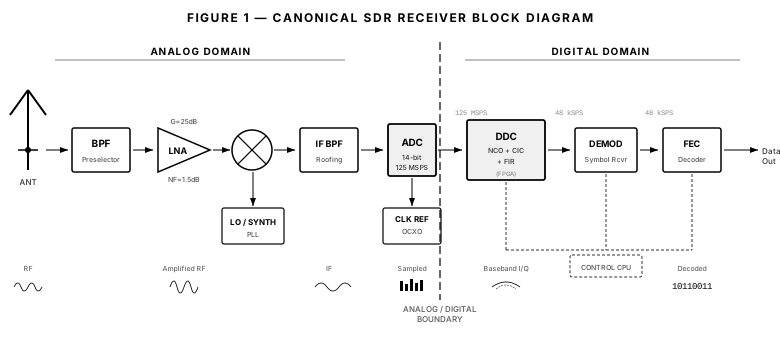
Figure 1 Canonical SDR receiver signal chain showing the complete path from antenna to decoded output. The dashed vertical line marks the analog-to-digital boundary. Sample rates are annotated at each stage. The LO/Synthesizer controls the analog mixer while the CLK REF (OCXO) provides the ADC sampling clock.
| Stage | Component | Domain | Function |
|---|---|---|---|
| 1 | Antenna | RF | Signal capture (50 Ω reference) |
| 2 | Preselector BPF | RF | Band selection, out-of-band rejection |
| 3 | LNA | RF | Low-noise amplification (20–30 dB) |
| 4 | Mixer + LO | RF | Frequency translation to IF (optional) |
| 5 | IF Filter | RF | Channel selectivity (roofing filter) |
| 6 | AGC | RF | Automatic gain control |
| 7 | Anti-alias Filter | RF | Sample rate-limited bandwidth |
| 8 | ADC | RF → Digital | Analog-to-digital conversion |
| 9 | DDC (NCO + CIC + FIR) | Digital | Digital down-conversion to baseband |
| 10 | Channelizer | Digital | Channel selection and filtering |
| 11 | Demodulator | Digital | Symbol recovery |
| 12 | FEC Decoder | Digital | Error correction and framing |
Table 3 SDR receiver signal chain stages.
The LO/Synthesizer controls the analog mixer (if present), while the NCO (Numerically-Controlled Oscillator) controls digital frequency translation in the DDC. Zero mixer stages corresponds to direct RF sampling; multiple mixer stages enable higher frequency operation with relaxed ADC requirements.
2.2 Architecture Classifications
The placement of the ADC relative to the antenna defines the SDR architecture classification. Each approach represents a different balance between analog complexity and digital processing demands:
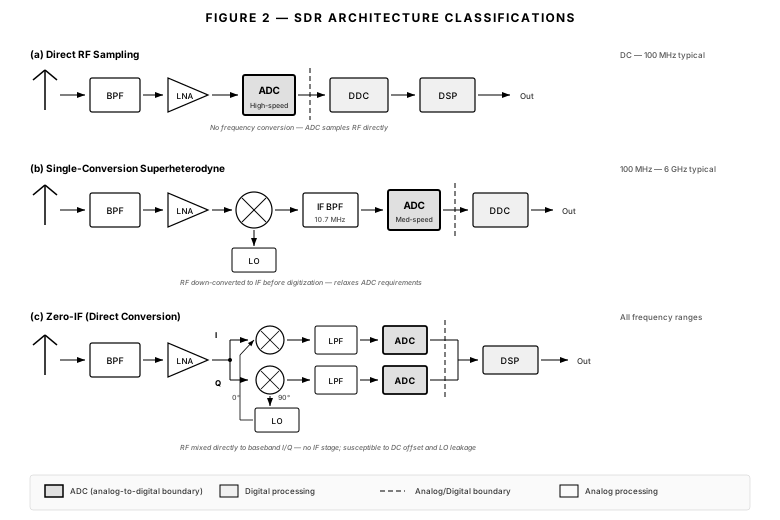
Figure 2 Three principal SDR architectures showing ADC placement (gray blocks). (a) Direct RF sampling eliminates the mixer entirely. (b) Superheterodyne conversion relaxes ADC bandwidth requirements at the cost of analog complexity. (c) Zero-IF produces baseband I/Q directly but introduces DC offset and LO leakage artifacts.
| Architecture | ADC Position | Typical Range | ADC Speed Required | Analog Complexity |
|---|---|---|---|---|
| Direct RF sampling | After LNA | DC–100 MHz | Very high (>250 MSPS) | Minimal |
| Single conversion | After one mixer | 100 MHz–6 GHz | Medium (50–250 MSPS) | Moderate |
| Dual conversion | After two mixers | 1–40 GHz | Low (10–50 MSPS) | High |
| Direct conversion (Zero-IF) | At baseband (I/Q) | All | Low–Medium | Moderate (I/Q paths) |
Table 4 SDR architecture classifications by ADC position.
2.3 Architecture Selection Criteria
The choice between architectures depends on operating frequency, instantaneous bandwidth, dynamic range requirements, and system complexity budget:
- HF bands (1.8–30 MHz): Direct RF sampling is preferred. Modern 14–16 bit ADCs at 125+ MSPS can digitize the entire HF spectrum in a single Nyquist zone. This is the architecture used in the ANAN-G2 and similar HPSDR platforms.
- VHF/UHF (30 MHz–3 GHz): Single conversion or direct conversion. The choice depends on whether wideband coverage (superhet) or integration density (zero-IF) is prioritized.
- Microwave (>3 GHz): Dual conversion is typical, though direct sampling ADCs are pushing into the 5–10 GHz range with RF-class ADCs (e.g., TI ADC12DJ5200RF at 10.4 GSPS).
3. RF Front-End Design
The RF front-end conditions the analog signal for digitization. Its performance establishes the system noise floor, dynamic range, and spurious-free operating region. Every component in the analog chain either adds noise or adds distortion — the art of front-end design is managing both simultaneously.
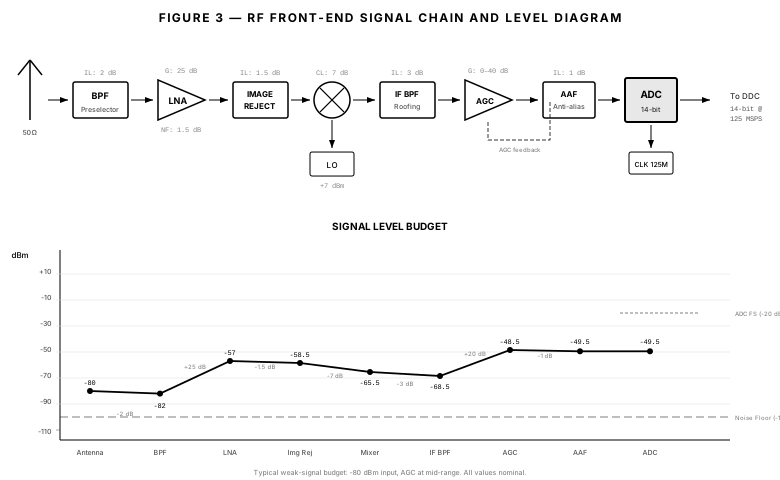
Figure 3 Complete RF front-end signal chain with component specifications. The lower portion shows the signal level budget for a typical weak-signal case (-80 dBm input), tracing power levels through each stage to the ADC input.
3.1 Low-Noise Amplifier
The LNA establishes system noise performance. The Friis equation for cascaded noise figure:
Ftotal = F1 + (F2 - 1)/G1 + (F3 - 1)/(G1G2) + … — Eq. (1)
Where F = noise factor (linear, not dB), G = gain (linear). The first-stage noise factor dominates total system noise figure because subsequent stage contributions are divided by the cumulative gain preceding them. This is why the LNA is the most critical component in the receiver chain.
For practical design, converting to dB:
NFtotal ≈ NFLNA + (NF2 - 1 dB) / GLNA — Eq. (2) (approximate, for high GLNA)
LNA design parameters vary by frequency range due to device physics and atmospheric noise:
| Parameter | HF (1.8–30 MHz) | VHF/UHF (30–1000 MHz) | Microwave (1–10 GHz) |
|---|---|---|---|
| Noise Figure | 1–3 dB | 0.5–1.5 dB | 0.8–2.0 dB |
| Gain | 20–30 dB | 15–25 dB | 15–20 dB |
| OIP3 | +20 to +30 dBm | +10 to +25 dBm | +5 to +15 dBm |
| P1dB | +10 to +15 dBm | 0 to +10 dBm | -5 to +5 dBm |
| Technology | JFET, BJT | GaAs pHEMT | GaAs/GaN MMIC |
Table 5 LNA specifications by frequency range.
Design note (HF): At HF frequencies, external noise (atmospheric, man-made) often exceeds thermal noise by 20–40 dB. This means LNA noise figure is less critical than linearity (IP3). A 3 dB NF LNA with +30 dBm OIP3 is preferable to a 0.5 dB NF LNA with +15 dBm OIP3 in an HF application.
3.2 Dynamic Range Analysis
The two critical dynamic range measures for an SDR front-end are:
Spurious-Free Dynamic Range (SFDR) — the ratio between a maximum on-channel signal and the largest spurious product from two-tone intermodulation:
SFDR = (2/3)(IIP3 - NFfloor) — Eq. (3)
Where NFfloor = -174 dBm/Hz + NF + 10 log10(BW).
Blocking Dynamic Range (BDR) — the ratio between a maximum off-channel signal (that compresses the receiver by 1 dB) and the minimum detectable signal:
BDR = P1dB - MDS — Eq. (4)
MDS = -174 + NF + 10 log10(BW) + SNRrequired — Eq. (5)
Worked example for an HF SDR receiver front-end (BW = 2.4 kHz SSB):
NF = 10 dB, IIP3 = +10 dBm, P1dB = 0 dBm
Noise Floor = -174 + 10 + 33.8 = -130.2 dBm
MDS = -130.2 + 10 (SNR for copy) = -120.2 dBm
SFDR = (2/3)(10 - (-130.2)) = 93.5 dB
BDR = 0 - (-120.2) = 120.2 dB
3.3 Mixing and Frequency Translation
Heterodyne conversion translates the RF signal to a lower intermediate frequency (IF) where filtering is easier and ADC requirements are relaxed:
fIF = |fRF - fLO| — Eq. (6)
The mixer is inherently a nonlinear device. An ideal mixer produces only sum and difference frequencies, but real mixers produce a family of intermodulation products at f = m · fRF ± n · fLO for all integer m, n. The most troublesome is the image response:
| Architecture | Image Frequency | Rejection Method | Typical Rejection |
|---|---|---|---|
| High-side injection | fRF + 2fIF | Preselector filter | >60 dB |
| Low-side injection | fRF - 2fIF | Preselector filter | >60 dB |
| Hartley image reject | N/A (cancelled) | I/Q phase cancellation | 30–45 dB |
| Weaver image reject | N/A (cancelled) | Dual conversion cancel | 40–55 dB |
Table 6 Image rejection by mixer architecture.
Mixer performance specifications:
| Parameter | Passive (diode ring) | Active (Gilbert cell) |
|---|---|---|
| Conversion loss/gain | -6 to -8 dB (loss) | +5 to +15 dB (gain) |
| IIP3 | +15 to +30 dBm | +5 to +15 dBm |
| Noise figure | 6–8 dB | 8–15 dB |
| LO drive | +7 to +17 dBm | -5 to +5 dBm |
| Port isolation | 30–40 dB | 20–35 dB |
Table 7 Mixer type comparison.
3.4 Automatic Gain Control
The AGC subsystem adjusts receiver gain to keep the ADC within its optimal operating range. The AGC must handle signals from the noise floor (approximately -130 dBm in 500 Hz BW) to strong local signals (+10 dBm at the antenna). This represents a ~140 dB dynamic range that must be compressed into the ADC’s ~80 dB range (14-bit).
AGC design parameters:
| Parameter | Typical Value | Design Rationale |
|---|---|---|
| Attack time | 1–10 ms | Fast enough to prevent ADC clipping |
| Decay time | 100–1000 ms | Slow enough to avoid pumping on speech |
| Gain range | 60–100 dB | Cover expected signal range |
| Gain steps | 0.5–1 dB | Fine enough for smooth AGC action |
| Threshold | ADC -6 dBFS | Leave headroom for peaks |
Table 8 AGC design parameters.
3.5 Anti-Aliasing Filter
The anti-aliasing filter (AAF) must attenuate all signals above fs/2 to below the ADC noise floor. For a 14-bit ADC (86 dB SNR), the AAF must provide at least 90 dB rejection at the Nyquist frequency.
For direct RF sampling of the HF band (0–62.5 MHz with fs = 125 MSPS), a 9th-order elliptic lowpass filter is typical:
| Parameter | Specification |
|---|---|
| Passband | DC–30 MHz |
| Passband ripple | <0.5 dB |
| -3 dB point | 35 MHz |
| Stop band start | 62.5 MHz |
| Stop band rejection | >90 dB |
| Insertion loss | <1 dB |
| Group delay variation | <50 ns across passband |
Table 9 Anti-aliasing filter specification for HF direct sampling.
4. Analog-to-Digital Conversion
The ADC is the pivotal component in any SDR system — it determines the instantaneous bandwidth, dynamic range, and ultimate sensitivity of the receiver. All signal processing after the ADC operates on quantized, sampled data, so any information lost at this stage cannot be recovered.
4.1 Fundamental Sampling Constraints
The Nyquist-Shannon sampling theorem requires:
fs ≥ 2 · B — Eq. (7)
Where fs = sample rate, B = signal bandwidth. This is the minimum for perfect reconstruction; in practice, oversampling ratios of 2.5–4× are used to ease anti-aliasing filter requirements and improve SNR through processing gain.
4.2 ADC Performance Parameters
| Parameter | Definition | Typical Range | Impact on SDR |
|---|---|---|---|
| Sample rate | Maximum conversion frequency | 10–500 MSPS | Sets instantaneous bandwidth |
| Resolution | Number of output bits | 8–16 bits | Sets theoretical dynamic range |
| ENOB | Effective bits after noise/distortion | 6–14 bits | Actual dynamic range |
| SNR | Signal-to-quantization-noise ratio | 50–96 dB | Weak signal sensitivity |
| SFDR | Spurious-free dynamic range | 60–100 dB | Strong signal handling |
| Aperture jitter | Sample timing uncertainty | 50–500 fs RMS | Limits usable bandwidth |
| Full-scale voltage | Maximum input swing | 1–2 Vpp | Sets input power reference |
Table 10 ADC performance parameters.
4.3 Quantization Noise
For an ideal N-bit ADC with a full-scale sinusoidal input, the signal-to-quantization-noise ratio is:
SNRq = 6.02N + 1.76 dB — Eq. (8)
This assumes quantization noise is uniformly distributed and white — an approximation that holds for signals much larger than 1 LSB. In practice, the Effective Number of Bits (ENOB) accounts for all noise and distortion:
ENOB = (SINAD - 1.76) / 6.02 — Eq. (9)
Where SINAD = Signal-to-Noise-and-Distortion ratio.
| Bits | Theoretical SNR | Typical ENOB | Typical SINAD | Dynamic Range |
|---|---|---|---|---|
| 8 | 49.9 dB | 7.0 | 43.9 dB | 48 dB |
| 12 | 74.0 dB | 10.5 | 65.0 dB | 72 dB |
| 14 | 86.0 dB | 12.0 | 74.0 dB | 84 dB |
| 16 | 98.1 dB | 13.5 | 83.0 dB | 96 dB |
Table 11 ADC resolution and effective performance.
4.4 Nyquist Zones and Bandpass Sampling
When the signal bandwidth B is narrow relative to carrier frequency fc, bandpass sampling (undersampling) enables digitization of signals above fs/2 by intentionally aliasing them into the first Nyquist zone:
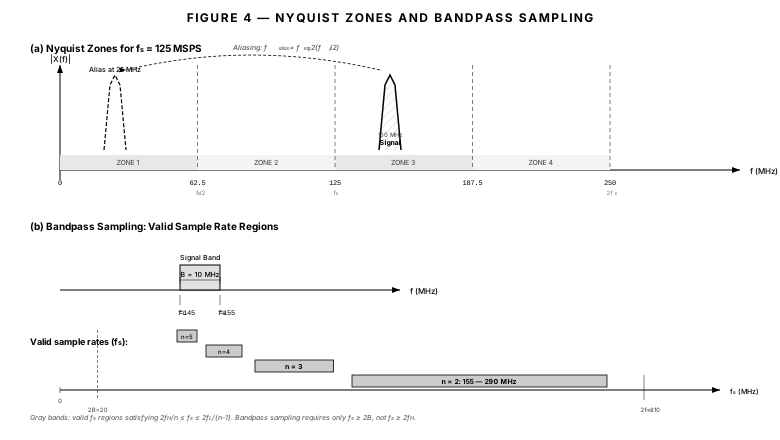
Figure 4 (a) Nyquist zones for fs = 125 MSPS. A signal at 150 MHz (Zone 3) aliases to 25 MHz in Zone 1. (b) Valid sample rate regions for a 10 MHz bandwidth signal centered at 150 MHz. The constraint is 2fH/n ≤ fs ≤ 2fL/(n-1).
The Nyquist zones are:
| Zone n | Frequency Range | Alias Behavior |
|---|---|---|
| 1 (baseband) | 0 to fs/2 | Direct (no aliasing) |
| 2 | fs/2 to fs | Spectrum inversion |
| 3 | fs to 3fs/2 | Direct (same as zone 1) |
| 4 | 3fs/2 to 2fs | Spectrum inversion |
Table 12 Nyquist zone properties. Even zones produce spectral inversion.
Valid bandpass sampling rates must satisfy:
2fH/n ≤ fs ≤ 2fL/(n-1) — Eq. (10)
Where fL, fH are signal band edges and n is the target Nyquist zone number.
4.5 Aperture Jitter Analysis
Clock jitter is the fundamental limit on ADC performance at high input frequencies. The SNR degradation from aperture jitter is:
SNRjitter = -20 log10(2π · fin · tj) — Eq. (11)
Where fin = input signal frequency and tj = RMS aperture jitter. This is independent of ADC resolution — jitter limits performance even for an infinite-bit ADC.
| Input Frequency | 100 fs jitter | 200 fs jitter | 500 fs jitter |
|---|---|---|---|
| 10 MHz | 90.1 dB | 84.0 dB | 76.0 dB |
| 30 MHz | 80.5 dB | 74.5 dB | 66.5 dB |
| 70 MHz | 73.1 dB | 67.1 dB | 59.1 dB |
| 150 MHz | 66.5 dB | 60.5 dB | 52.5 dB |
| 500 MHz | 56.0 dB | 50.0 dB | 42.0 dB |
Table 13 SNR limit from aperture jitter (dB). Values below the ADC’s native SNR become the system bottleneck.
This is why high-quality clock sources (OCXO or low-jitter crystal oscillators) are critical for SDR performance, especially when using bandpass sampling of high-frequency signals.
4.6 Processing Gain from Oversampling
Oversampling provides processing gain that effectively increases ADC resolution. When sampling at M times the Nyquist rate, then decimating by M:
SNRimprovement = 10 log10(M) — Eq. (12)
Every factor of 4 in oversampling adds approximately 1 effective bit (6 dB). For an HF SDR sampling at 125 MSPS with a 3 kHz SSB channel:
M = 125,000,000 / (2 × 3,000) = 20,833
Processing gain = 10 log10(20,833) = 43.2 dB ≈ 7.2 additional bits
This is why a 14-bit ADC at 125 MSPS can achieve an effective dynamic range exceeding 120 dB in a narrow channel — the oversampling ratio is enormous.
5. Digital Down-Conversion
The DDC translates a digitized signal from its sampled IF (or RF) frequency down to complex baseband (I/Q), while simultaneously reducing the sample rate through decimation. This is the digital equivalent of the analog mixer + filter chain, but with perfect repeatability and zero drift.
5.1 DDC Architecture
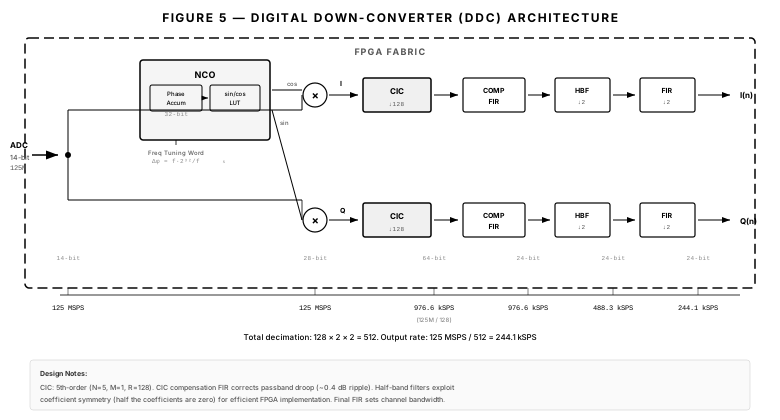
Figure 5 Complete DDC architecture showing dual I/Q paths. The NCO generates quadrature (cos/sin) sequences that mix the digitized signal to baseband. The CIC filter performs coarse decimation (128×), followed by compensation FIR, half-band filter (2× decimation), and final channel-selection FIR (2×). Total decimation = 512, reducing 125 MSPS to 244.1 kSPS. Bit widths grow through the CIC due to accumulator bit growth and are truncated after compensation.
5.2 Numerically-Controlled Oscillator
The NCO generates digital sine/cosine sequences for frequency translation. It replaces the analog LO/VCO with a purely digital frequency synthesizer that has zero phase noise, infinite tuning resolution, and instantaneous frequency switching.
The NCO consists of a phase accumulator and a sin/cos lookup table (or CORDIC processor):
φ[n] = (φ[n-1] + Δφ) mod 2W — Eq. (13)
ILO[n] = cos(2πφ[n] / 2W) — Eq. (14a)
QLO[n] = sin(2πφ[n] / 2W) — Eq. (14b)
Where W = phase accumulator width (bits) and Δφ = frequency tuning word.
The frequency tuning word relates to the desired output frequency:
Δφ = round(fNCO · 2W / fs) — Eq. (15)
| Parameter | Typical Value | Design Impact |
|---|---|---|
| Phase accumulator width | 32 bits | Frequency resolution: fs/232 = 0.029 Hz at 125 MSPS |
| LUT size | 212 to 214 entries | SFDR: >100 dBc with 14-bit LUT |
| Output width | 16–18 bits | Sufficient for 14-bit ADC data |
| Spurious performance | -100 to -120 dBc | Dithering and Taylor correction improve this |
| Switching time | 1 sample period (8 ns) | Instantaneous retuning |
Table 14 NCO performance parameters.
CORDIC vs. LUT: FPGA implementations may use CORDIC (COordinate Rotation DIgital Computer) instead of a lookup table. CORDIC computes sin/cos iteratively using only shifts and adds (no multipliers), trading area for latency. LUT approaches are faster but consume block RAM. Modern FPGAs often have enough block RAM that a quarter-wave LUT with symmetry exploitation is preferred.
5.3 Digital Mixing
Complex mixing translates the signal to baseband. The input real-valued sample x[n] is multiplied by both quadrature components:
IBB[n] = x[n] · cos(2πfNCOn/fs) — Eq. (16a)
QBB[n] = -x[n] · sin(2πfNCOn/fs) — Eq. (16b)
The result is a complex baseband signal z[n] = I[n] + jQ[n]. This contains both the desired signal (now centered at DC) and a double-frequency component at 2fNCO that must be removed by subsequent filtering. The complex representation preserves both amplitude and phase information, enabling coherent demodulation of any modulation type.
5.4 CIC Decimation Filter
The Cascaded Integrator-Comb (CIC) filter is the workhorse of high-ratio decimation in SDR systems because it requires no multiplications — only additions and subtractions — making it extremely resource-efficient on FPGAs.
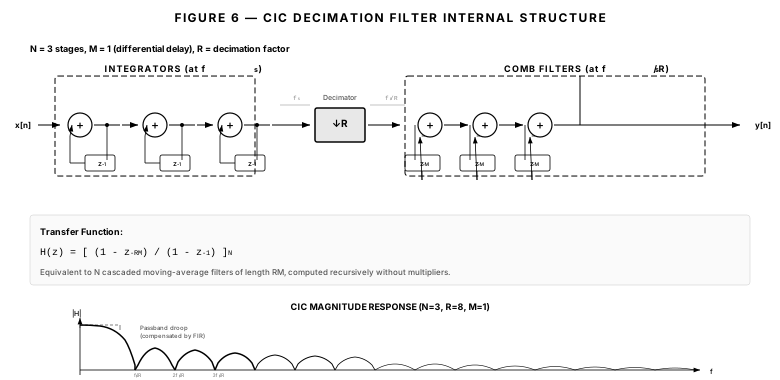
Figure 6 Internal structure of a 3rd-order CIC decimation filter. The integrator section runs at the input sample rate fs, accumulating sums via recursive feedback. The rate change element discards R-1 of every R samples. The comb section runs at the reduced rate fs/R, computing running differences. The bottom shows the sinc-like magnitude response with nulls at multiples of fs/R.
The CIC transfer function is:
H(z) = [(1 - z-RM) / (1 - z-1)]N — Eq. (17)
Where R = decimation rate, M = differential delay (usually 1), N = number of stages.
The magnitude response is a sincN function:
|H(f)| = |sin(πMRf/fs) / sin(πf/fs)|N — Eq. (18)
| CIC Design Parameter | Typical Value | Consideration |
|---|---|---|
| Order (N) | 3–5 | Higher order = more out-of-band rejection, more passband droop |
| Decimation (R) | 8–256 | Higher R requires more integrator bits |
| Differential delay (M) | 1 | M=2 improves alias rejection but doubles bit growth |
| Integrator bit width | N·log2(RM) + Bin | Must accommodate full bit growth |
| Passband droop at 0.4·fout/2 | 0.3–1.5 dB | Compensated by subsequent FIR |
Table 15 CIC filter design parameters.
Bit growth: The CIC integrator accumulators grow by N·log2(RM) bits. For N=5, R=128, M=1: growth = 5 × 7 = 35 bits. Starting from 14-bit ADC data, the integrator must be at least 49 bits wide. The comb output is then truncated back to a manageable width (typically 24 bits) before the compensation FIR.
5.5 Decimation Filter Chain
After the CIC, a chain of progressively finer filters shapes the final channel response:
| Stage | Filter Type | Decimation | Purpose | Coefficients |
|---|---|---|---|---|
| 1 | CIC | 64–256× | Coarse decimation, no multipliers | 0 (recursive) |
| 2 | Compensation FIR | 1× | Correct CIC passband droop (sinc-N) | 15–31 taps |
| 3 | Half-band FIR | 2× | Transition band shaping | ~50% are zero |
| 4 | Channel FIR | 2–4× | Final channel selectivity | 32–128 taps |
Table 16 Typical DDC decimation filter chain.
Half-band filters are particularly efficient because approximately half their coefficients are exactly zero (by the half-band design constraint), halving the multiply count. The center coefficient is exactly 0.5, further saving one multiplication.
6. Baseband Signal Processing
6.1 I/Q Signal Processing
All modern SDR systems represent signals as complex baseband (I/Q) pairs. This representation is fundamental to coherent processing because it preserves the full analytic signal — both amplitude and instantaneous phase.
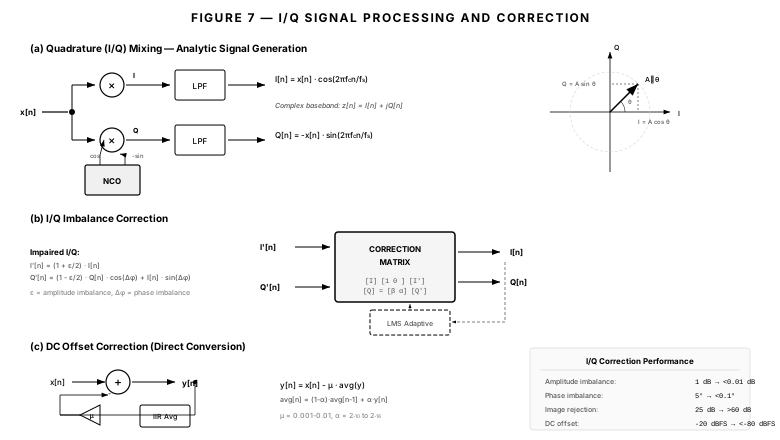
Figure 7 (a) Quadrature mixing concept: the input is multiplied by cos and -sin from the NCO to produce I and Q components. The complex baseband signal z[n] = I[n] + jQ[n] is a single-sideband analytic representation. The constellation diagram shows how I and Q encode amplitude and phase. (b) I/Q imbalance correction using an adaptive matrix. (c) DC offset removal using an IIR averaging loop.
Key properties of complex baseband:
- Instantaneous amplitude: A[n] = √(I[n]2 + Q[n]2)
- Instantaneous phase: θ[n] = arctan(Q[n] / I[n])
- Instantaneous frequency: f[n] = (1/2π) · dθ/dt ≈ (θ[n] - θ[n-1]) · fs / (2π)
- Positive/negative frequency discrimination: Complex signals distinguish +f from -f, enabling SSB reception and image rejection in the digital domain.
6.2 Channelization
For multi-channel reception (e.g., monitoring multiple frequencies simultaneously), polyphase filter banks efficiently extract multiple channels from a wideband digitized spectrum:
| Method | Channels | Computational Efficiency | Channel Flexibility |
|---|---|---|---|
| Per-channel DDC | 1–8 | Low (N · single DDC) | Full (arbitrary tuning) |
| Polyphase filter bank | 16–1024 | High (shared computation) | Low (uniform spacing) |
| DFT filter bank (PFB-FFT) | 64–4096 | Very high (FFT-based) | Low (uniform spacing) |
| Non-uniform filter bank | Variable | Medium | High (arbitrary bandwidths) |
Table 17 Channelization approaches.
The polyphase filter bank + FFT (PFB-FFT) channelizer is the most computationally efficient approach for large numbers of uniformly-spaced channels. It computes all channels simultaneously using a polyphase decomposition of a prototype lowpass filter followed by an FFT. For K channels, the computational cost is O(K log2 K) per output sample, compared to O(K2) for individual DDCs.
6.3 Demodulation Algorithms
With the signal at complex baseband, demodulation extracts the information-bearing content:
| Modulation | Algorithm | Complexity (MFLOPS/ksps) | Key Operations |
|---|---|---|---|
| AM | Envelope detection: √(I2+Q2) | 2 | Magnitude computation |
| FM | Arctan differentiation: dθ/dt | 10 | Arctangent, subtract |
| SSB | Weaver or phasing method | 15 | Hilbert FIR, add/subtract |
| CW | Narrow BPF + envelope | 5 | FIR filter, magnitude |
| BPSK/QPSK | Costas loop + matched filter | 30 | PLL, correlator |
| 16-QAM | Carrier recovery + equalizer | 50 | PLL, LMS adaptive filter |
| OFDM | FFT + channel estimation | 100 | FFT, matrix inversion |
Table 18 Demodulation computational requirements.
6.4 Synchronization
Reliable demodulation requires four synchronization functions, each operating at a different time scale:
| Function | Algorithm | Convergence | Accuracy Required |
|---|---|---|---|
| Coarse frequency | FFT peak detection | Fast (1 block) | ±1 sub-carrier |
| Fine frequency | PLL (2nd-order type II) | Moderate (10–100 symbols) | <1% of symbol rate |
| Symbol timing | Gardner TED, Mueller-Müller | Moderate (50–200 symbols) | <5% of symbol period |
| Frame sync | Correlation with known preamble | Fast (1 frame) | Exact alignment |
Table 19 Synchronization functions and algorithms.
The Phase-Locked Loop (PLL) is the fundamental building block for carrier and timing recovery. A digital PLL consists of:
- Phase detector — measures phase error between input and local reference (multiply + filter)
- Loop filter — a proportional-integral (PI) controller that determines tracking bandwidth and damping
- NCO — generates the local frequency/phase reference from the filtered error
The loop bandwidth BL controls the trade-off between noise rejection (narrow BL) and acquisition speed (wide BL). Typical values range from 0.01 · Rsym to 0.05 · Rsym.
7. Implementation Platforms
7.1 FPGA-CPU Partitioning
Modern SDR systems use a heterogeneous architecture: an FPGA handles the high-sample-rate, deterministic processing, while a CPU handles complex, variable-rate algorithms. The boundary between them is set by sample rate and algorithmic complexity.
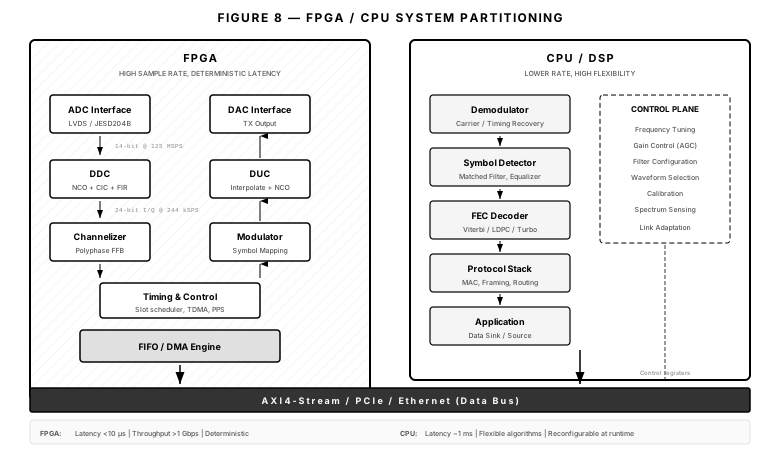
Figure 8 System partitioning between FPGA and CPU domains. The FPGA handles all high-rate DSP (ADC interface, DDC, channelization, modulation/demodulation kernels, timing control) and interfaces to the CPU via DMA/FIFO over AXI4-Stream, PCIe, or Ethernet. The CPU runs flexible algorithms (FEC decoding, protocol stacks, applications) and provides control-plane functions (frequency tuning, AGC, calibration).
7.2 Processing Element Comparison
| Platform | Sample Throughput | Latency | Power/GFLOP | Reconfigurability |
|---|---|---|---|---|
| FPGA | 1–10 GSPS | 10 ns – 10 μs | 5–20 mW | Medium (recompile) |
| DSP (C66x, SHARC) | 100–500 MSPS | 1–100 μs | 50–200 mW | High (firmware) |
| GPU | 1–5 GSPS | 100 μs – 10 ms | 100–500 mW | High (CUDA/OpenCL) |
| CPU (ARM/x86) | 10–100 MSPS | 10 μs – 10 ms | 500–2000 mW | Very high (software) |
Table 20 SDR processing platform comparison (per GFLOP).
7.3 Typical Function-to-Platform Mapping
| Function | Implementation | Rationale |
|---|---|---|
| ADC/DAC interface | FPGA | Wire-speed, deterministic timing |
| DDC/DUC | FPGA | Sample rate >>1 MSPS, parallel multiply |
| CIC decimation | FPGA | No multipliers needed, pure logic |
| Channelizer (PFB-FFT) | FPGA | Massive parallelism, deterministic |
| Modulation (simple) | FPGA | Low latency for TDMA timing |
| Demodulation (complex) | FPGA or DSP | Depends on modulation complexity |
| FEC encode/decode | DSP or CPU | Algorithmic complexity (Viterbi, LDPC) |
| Protocol stack (MAC) | CPU | State machine complexity, flexibility |
| Timing/scheduler | FPGA | Sub-microsecond determinism |
| Spectrum sensing | CPU | Complex analysis, display |
Table 21 Function-to-platform mapping rationale.
7.4 Data Transport
The interface between FPGA and CPU must sustain the post-decimation data rate without dropping samples:
| Interface | Bandwidth | Latency | Typical Use |
|---|---|---|---|
| AXI4-Stream (on-chip) | 1–10 Gbps | <100 ns | SoC (Zynq, Intel SoC) |
| PCIe Gen3 x4 | 32 Gbps | 1–5 μs | Discrete FPGA + host |
| 10GbE | 10 Gbps | 10–50 μs | Networked SDR (HPSDR) |
| 1GbE | 1 Gbps | 50–200 μs | Low-bandwidth SDR |
| USB 3.0 | 5 Gbps | 0.1–1 ms | Consumer SDR dongles |
Table 22 FPGA-to-CPU data transport options.
The ANAN-G2 (HPSDR architecture) uses Gigabit Ethernet, which provides 1 Gbps raw bandwidth — sufficient for multiple simultaneous DDC channels at 48–192 kSPS each, while also providing natural network isolation and long cable runs.
8. Practical Considerations
8.1 DC Offset Correction
Direct-conversion and zero-IF receivers exhibit a DC offset from LO-to-RF leakage through the mixer. This produces a spectral spike at the center frequency that can mask weak signals.
Digital correction uses an IIR high-pass filter:
y[n] = x[n] - μ · avg[n] — Eq. (19)
avg[n] = (1 - α) · avg[n-1] + α · y[n] — Eq. (20)
Where μ ≈ 1.0, α = 2-10 to 2-16. The time constant must be slow enough not to distort low-frequency signal content. For SSB voice (300 Hz lower cutoff), α = 2-14 at 48 kSPS gives a -3 dB point of approximately 3 Hz — well below the audio passband.
8.2 I/Q Imbalance Correction
Amplitude and phase mismatch between I and Q channels creates an unwanted image response — a mirror of the desired signal reflected about the tuned frequency. In analog I/Q systems (direct conversion), this is unavoidable due to component tolerances.
| Parameter | Typical Uncorrected | After Digital Calibration |
|---|---|---|
| Amplitude imbalance | 0.1–1.0 dB | <0.01 dB |
| Phase imbalance | 1–5° | <0.1° |
| Image rejection | 25–40 dB | >60 dB |
Table 23 I/Q imbalance correction performance.
Adaptive correction using a 2×2 matrix:
Icorrected[n] = I’[n] — Eq. (21a)
Qcorrected[n] = α · Q’[n] + β · I’[n] — Eq. (21b)
Where α and β are adaptively estimated using LMS (Least Mean Square) or blind source separation algorithms. The adaptation minimizes the cross-correlation between corrected I and Q channels.
8.3 Spurious Management
Digital spurs arise from NCO phase truncation, finite-precision arithmetic, and clock feedthrough. Key mitigation strategies:
| Spur Source | Mechanism | Mitigation | Typical Improvement |
|---|---|---|---|
| NCO phase truncation | Periodic error in sin/cos | Phase dithering | 20–30 dB |
| NCO amplitude truncation | Quantized sine values | Taylor series correction | 10–20 dB |
| ADC clock feedthrough | Digital switching on analog supply | Layout isolation, LDO filtering | 10–30 dB |
| CIC passband aliasing | Folded out-of-band noise | Increased CIC order | 6 dB per order |
| FIR coefficient quantization | Rounded filter coefficients | Wider coefficient word | 6 dB per bit |
Table 24 Digital spur sources and mitigations.
8.4 Phase Noise Budget
For coherent demodulation (PSK, QAM), the total phase noise from all sources must be below the modulation’s phase tolerance:
| Source | Typical Contribution | Notes |
|---|---|---|
| LO synthesizer | -80 to -110 dBc/Hz @ 10 kHz | Dominates in superheterodyne |
| ADC clock jitter | -100 to -130 dBc/Hz @ 10 kHz | OCXO: <100 fs jitter |
| NCO (digital) | Negligible | Deterministic, no phase noise |
| PLL (carrier recovery) | Depends on loop BW | Integration of VCO noise |
Table 25 Phase noise contributions by source.
For QPSK with a target BER of 10-6, the integrated phase noise must be below approximately 5° RMS. For 16-QAM, this drops to approximately 2° RMS.
9. Design Example: HF Direct-Sampling SDR Receiver
This section presents a complete worked design for an HF-band direct-sampling SDR receiver suitable for amateur radio and maritime communications (1.8–30 MHz).
9.1 System Requirements
| Parameter | Requirement |
|---|---|
| Frequency range | 1.8–30 MHz |
| Instantaneous bandwidth | 62.5 MHz (full first Nyquist zone) |
| Channel bandwidth | 100 Hz (CW) to 12 kHz (AM) |
| Minimum discernible signal | -130 dBm (500 Hz BW) |
| Blocking dynamic range | >120 dB |
| SFDR | >90 dB (in-channel) |
| Output data rate | 48 kSPS complex I/Q per channel |
| Simultaneous channels | Up to 7 |
Table 26 HF SDR receiver system requirements.
9.2 Component Selection
| Component | Selection | Key Specification |
|---|---|---|
| ADC | LTC2208 (Linear Tech) | 16-bit, 130 MSPS, 79.2 dB SNR |
| Clock | OCXO, 125 MHz | Phase noise: -155 dBc/Hz @ 10 kHz, jitter <80 fs |
| LNA | Mini-Circuits PGA-103+ | NF: 0.5 dB, OIP3: +37 dBm, G: 26 dB |
| Preselector | Switched BPF bank (160m–10m) | IL: <2 dB, rejection >60 dB |
| FPGA | Xilinx Artix-7 (XC7A100T) | 101K LUTs, 4.9 Mb BRAM, 240 DSP48 |
| CPU | ARM Cortex-A53 (CM5) | 1.5 GHz quad-core, GbE |
| Interface | Gigabit Ethernet | 1 Gbps, HPSDR protocol |
Table 27 Component selection for HF SDR receiver.
9.3 Signal Budget
| Point | Signal Level | Noise Floor | SNR |
|---|---|---|---|
| Antenna (30 MHz, 500 Hz BW) | -80 dBm | -147 dBm | 67 dB |
| After preselector (IL=2 dB) | -82 dBm | -145 dBm | 63 dB |
| After LNA (G=26 dB, NF=0.5 dB) | -56 dBm | -119.5 dBm | 63.5 dB |
| ADC input | -56 dBm | -119.5 dBm | 63.5 dB |
| ADC output (16-bit, 125 MSPS) | — | -174+10+81 = -83 dBFS | 79 dB (ADC) |
| After DDC (500 Hz BW) | — | Processing gain: 44 dB | 123 dB effective |
Table 28 Signal level budget through the receiver chain.
9.4 FPGA Resource Utilization
| Function | LUTs | DSP48 Slices | BRAM (Kb) |
|---|---|---|---|
| ADC interface (LVDS) | 200 | 0 | 0 |
| NCO (32-bit, quarter-wave LUT) | 150 | 2 | 18 |
| CIC filter (5th order, 128×) | 1,200 | 0 | 0 |
| Compensation FIR (21 taps) | 400 | 11 | 2 |
| Half-band filter (47 taps) | 300 | 12 | 2 |
| Channel FIR (63 taps) | 500 | 16 | 4 |
| Per DDC channel total | 2,750 | 41 | 26 |
| 7 channels | 19,250 | 287 | 182 |
| GbE MAC + DMA | 5,000 | 0 | 36 |
| Timing/control | 2,000 | 0 | 8 |
| System total | 26,250 | 287 | 226 |
| Artix-7 100T capacity | 101,440 | 240 | 4,860 |
| Utilization | 26% | 120% | 5% |
Table 29 FPGA resource utilization estimate.
Note: DSP48 utilization exceeds 100%, indicating that either time-multiplexing of DSP slices is required (feasible since channel FIR runs at 488 kSPS, far below the DSP48’s 500 MHz clock), or the Artix-7 200T variant should be selected.
10. References
- Mitola, J., “Software Radio Architecture: A Mathematical Perspective,” IEEE JSAC, vol. 17, no. 4, pp. 514–538, 1999.
- Hentschel, T., Sample Rate Conversion in Software Configurable Radios, Artech House, 2002.
- Tsui, J.B.Y., Digital Techniques for Wideband Receivers, 2nd ed., Artech House, 2001.
- Harris, F.J., Multirate Signal Processing for Communication Systems, Prentice Hall, 2004.
- Lyons, R.G., Understanding Digital Signal Processing, 3rd ed., Prentice Hall, 2010.
- Hogenauer, E.B., “An Economical Class of Digital Filters for Decimation and Interpolation,” IEEE Trans. ASSP, vol. 29, no. 2, pp. 155–162, 1981.
- Rice, M., Digital Communications: A Discrete-Time Approach, Prentice Hall, 2009.
- Proakis, J.G. and Manolakis, D.G., Digital Signal Processing: Principles, Algorithms, and Applications, 4th ed., Pearson, 2006.
- Razavi, B., RF Microelectronics, 2nd ed., Prentice Hall, 2011.
- Vankka, J. and Halonen, K., Direct Digital Synthesizers: Theory, Design and Applications, Springer, 2001.
- Zanchi, A. and Buchanan, C., “Effects of Aperture Jitter on ADC Performance,” Analog Dialogue, vol. 42, no. 2, 2008.
- Analog Devices, “Understanding High Speed ADC Testing and Evaluation,” Application Note AN-835, 2017.